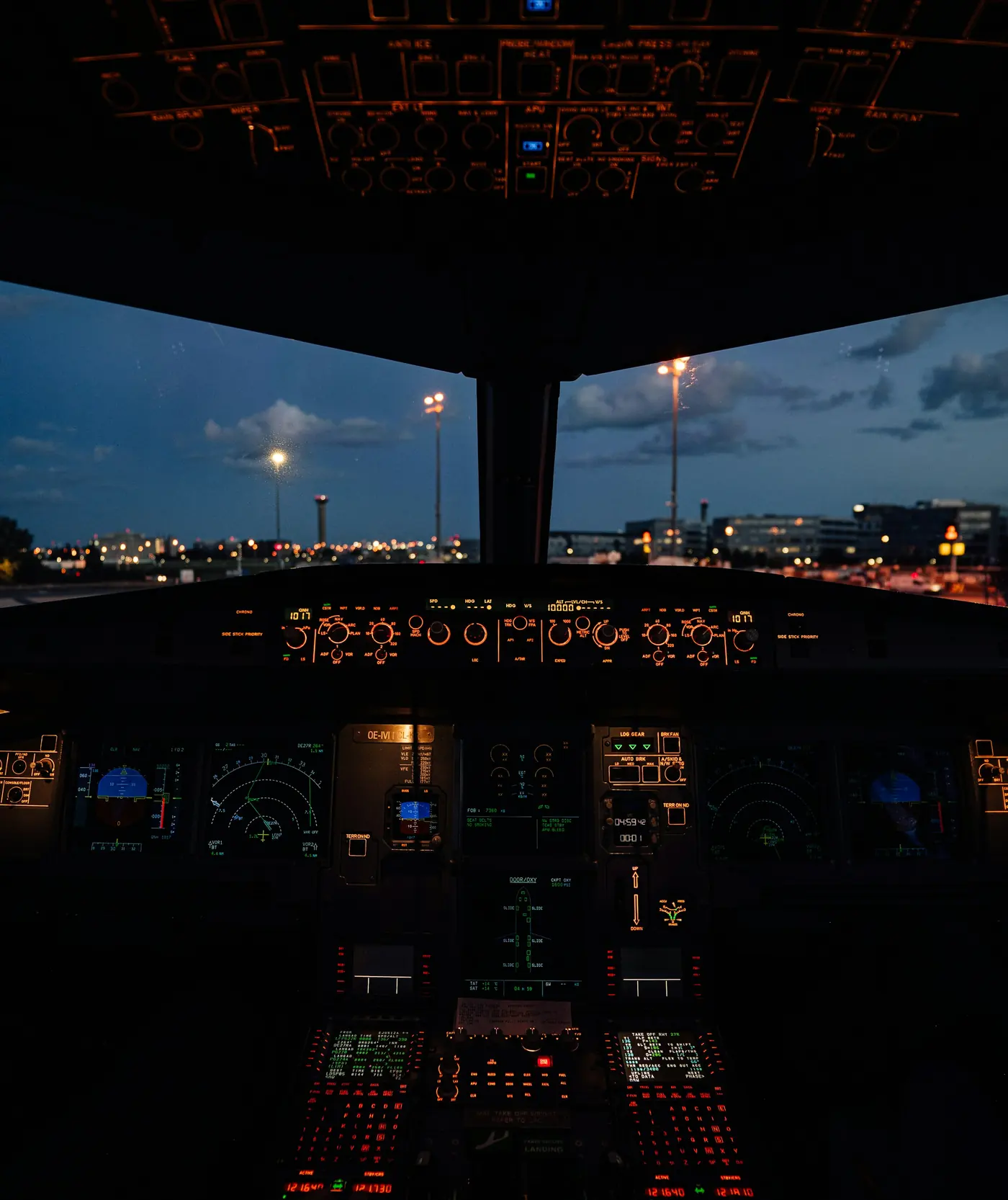
Online training for pilots, from RVSM to performance.
Four online courses, with recorded lessons in the student portal and a certificate issued by Alis at the end: RVSM and CPDLC for the LOA, RBAC 117 Appendix E for the ANAC authorization and aircraft performance for general aviation.
Pick your course. One-time payment, per student.
Recorded lessons in the student portal and a certificate issued by Alis at the end. One purchase per student, each with their own account.
- LOA · IS No. 91-005
RVSM
US$78
See the course - LOA · IS No. 91-010
CPDLC
US$78
See the course - ANAC authorization · IS No. 117-007
RBAC 117 · Appendix E
US$78
See the course - 8 hours · general aviation
Aircraft performance
US$298
See the course
Online purchase coming soon. To start sooner, talk to the team.
RVSM training for your LOA.
To fly between FL 290 and FL 410 with 1,000 ft vertical separation, the operator needs authorization from ANAC. Under RBAC 91, it is issued as a letter of authorization (LOA), and the operator declares that the crew is familiar with the procedures of IS No. 91-005. This training prepares the crew and delivers the certificate.
When the lessons are finished, the certificate is issued by Alis. The operator keeps the record and uses it to support the familiarization statement in the Technical Report.
RVSM
- Content aligned with IS No. 91-005, Revision F
- Procedures, contingencies and phraseology
- Qualified instructor
- Certificate of completion
- Access to the student portal
Online purchase coming soon. To start sooner, talk to the team.
ANAC looks at the aircraft, the operator and the crew.
IS No. 91-005 describes the operational authorization process for RVSM. For RBAC 91 operators outside Subpart K, it ends in a letter of authorization. The training takes care of the crew's part.
Demonstrated RVSM capability
The RVSM report (Laudo RVSM, form F-900-44) is completed and signed by a maintenance organization certified for the model. It is valid for 2 years from the date of signature.
Formal application through SEI
The Technical Report is submitted on a digital form, with the aircraft's transponder code. In it the operator declares that the crew will be familiar with the procedures and practices of the IS.
Procedures mastered
This is where the training comes in: planning, preflight, entry into RVSM airspace, cross-checks, contingencies and phraseology, as described in Appendices E and F of the IS.
Source: IS No. 91-005, Revision F (ANAC), in force since 01/01/2025. The IS is an acceptable means of compliance, and the official text prevails. Operating under RBAC 135 or Subpart K of RBAC 91? The authorization is issued in the Operations Specifications or the Management Specifications (Especificações Administrativas), and RVSM training becomes part of the operator's training program.
What the crew learns.
The content follows the training syllabus in Appendix F of IS No. 91-005 and the operating procedures in Appendix E.
Fundamentals
What RVSM airspace is and what the aircraft needs in order to enter it.
Introduction to RVSM
Definition, history, airspace zones and implementation in the different regions.
Required systems
Two primary altitude measurement systems, automatic altitude control, altitude alerting and an altitude-reporting transponder.
Airworthiness and monitoring
Continued airworthiness, MEL and monitoring of altitude-keeping capability (HMU and GMU).
Operating procedures
From flight planning to cruise level.
Flight planning
Aircraft and operator approval, the letter W in the flight plan, en route weather and minimum equipment.
Preflight
Technical records, static ports on the external inspection and altimeter check on the ground, with the 75 ft limit.
Before entry and in flight
Equipment operating, altimeter cross-check every hour, 200 ft limit between the primary altimeters and altitude deviation reported by ATC.
Contingencies and phraseology
What to do and what to say when something does not go as planned.
En route failures
En route equipment failures and contingency procedures in the RVSM airspace where the flight is intended.
Phraseology and cross-checking
Standard ATC phraseology for each area and cross-checking between crew members to comply with clearances promptly and without error.
Standby altimeter and visual perception
Use and limitations of the standby altimeter in contingencies and the perception of another aircraft at 1,000 ft separation at night.
Regional procedures
Particularities of each RVSM region and the NAT-HLA for those crossing the North Atlantic.
Questions about RVSM.
Who needs a LOA for RVSM?+
Is the training alone enough to obtain the LOA?+
What does the IS require of the crew?+
Does the RVSM report (Laudo RVSM) have a validity period?+
I am going to cross the North Atlantic. Is the RVSM LOA enough?+
CPDLC training for your LOA.
Using controller-pilot data link communications (CPDLC) and ADS-C requires authorization from ANAC. Under RBAC 91, it is issued as a letter of authorization (LOA), and the pilots need to be familiar with all the training topics of IS No. 91-010. This training covers those topics and delivers the certificate.
When the lessons are finished, the certificate is issued by Alis. The content covers concepts and procedures. Operating the equipment installed on your aircraft follows the AFM and the manufacturer's manuals.
CPDLC
- Content aligned with IS No. 91-010, Revision D
- CPDLC, ADS-C, RCP and RSP
- Qualified instructor
- Certificate of completion
- Access to the student portal
Online purchase coming soon. To start sooner, talk to the team.
Two approvals: the aircraft's and the operator's.
IS No. 91-010 treats the use of CPDLC and ADS-C as a single process with two approvals: airworthiness, which belongs to the aircraft, and operational authorization, which belongs to the operator. The training takes care of the pilots' part.
Suitable equipment
Documentation showing that the data link equipment meets the intended application: manufacturer, model, interoperability designator and compatible subnetworks.
Petition through SEI
The Technical Report states the model, the application (CPDLC, ADS-C or both), the contracted communication providers and whether there is interest in a PBCS specification. The LOA is an authorization of the operator.
Data link proficiency
The IS requires pilots who are proficient in data link standards and procedures and familiar with all the training topics it describes. That is what this training covers.
Source: IS No. 91-010, Revision D (ANAC), approved by Portaria No. 17.754/SPO of 27/08/2025. The IS is an acceptable means of compliance, and the official text prevails. Operating under RBAC 135 or Subpart K of RBAC 91? The authorization is issued in the Operations Specifications or the Management Specifications (Especificações Administrativas), with data link in the operator's training program.
What the pilots learn.
The content follows the knowledge and procedures that IS No. 91-010 lists for pilot training in data link communications.
Knowledge
How data link works and what each message means.
Services and technologies
Terminology, structure of data link services and systems theory as far as it matters for operational use.
Messages and responses
WILCO, ROGER, UNABLE and STANDBY, with the terms, abbreviations and conventions of each environment: ground, continental routes and oceanic routes.
RCP, RSP and reduced separation
Communication and surveillance performance specifications, with RCP 240 and RSP 180.
Limitations, MEL and flight plan
AFM limitations, MEL items that affect data link and the correct designators in the flight plan.
Procedures
From logon to response, including what to do when the connection drops.
Logon and connection
Starting and ending the operation, logging on and restoring the system after losing the network connection.
Compose, send and respond
Accepting, rejecting, canceling, storing and retrieving messages, and loading FMS data when applicable.
Deviations and route
Weather deviations, offset navigation and waypoint sequencing.
Failures and alerts
System advisories, failure recognition and procedures in the event of a data link communication failure.
Human factors
Where error tends to get in and how the crew stops it.
CRM in data link
Independent verification of each message, discussion between the crew members and a decision before responding.
A message that was not clear
How to clarify with the ATS unit a message that is unclear or cannot be accepted.
Occurrence reporting
The occurrence reporting system for data link communications.
Questions about CPDLC.
Who needs a LOA for CPDLC?+
What does ANAC assess in the application?+
Is the CPDLC training enough to get the LOA?+
Does the training cover ADS-C and PBCS?+
Do I need CPDLC to cross the North Atlantic?+
Fatigue training for operating under Appendix E.
Appendix E of RBAC 117 sets duty period and flight time limits specific to general aviation in jet airplanes with two or more pilots. To use them, the operator applies to ANAC for registration and authorization and trains the crew before starting. This training follows the curriculum of IS No. 117-007 and delivers the certificate.
When the lessons are finished, the certificate is issued by Alis. The operator keeps the training record, which the regulation requires to be kept for at least 5 years.
RBAC 117 · Appendix E
- Curriculum of IS No. 117-007, Revision A
- Fatigue, Appendix E limits and reporting
- Qualified instructor
- Certificate of completion
- Access to the student portal
Online purchase coming soon. To start sooner, talk to the team.
Registration, authorization and a trained crew.
In everyday use it is commonly called a LOA. In the regulation, the name is registration and authorization: the operator applies through SEI, ANAC replies by official letter and the authorization is tied to the operator, not to the aircraft.
Private jet operations
RBAC 91 operators in not-for-profit operations, with hired pilots, in jet airplanes with two or more pilots. It does not apply to fractional ownership under Subpart K.
Registration and authorization through SEI
Electronic form, proof of address and the operator's declaration on fitness for duty, fatigue management, crew member training and just culture.
Trained before starting
All crew members involved must be trained before operations under Appendix E begin, with initial and recurrent training.
Source: RBAC No. 117, Amendment 01 (paragraph 117.15(b), section 117.65 and Appendix E) and IS No. 117-007, Revision A (ANAC). The IS is an acceptable means of compliance, and the official text prevails.
What the crew learns.
The content follows the minimum initial training curriculum in Appendix A of IS No. 117-007.
Fatigue
What it is, where it comes from and what it does to performance.
Basic concepts
What fatigue is and the difference between acute and cumulative fatigue.
Factors that affect fatigue
Circadian rhythm, recent sleep, time awake, workload, accumulated duty periods, time zones, alcohol and nicotine.
Signs and symptoms
Physical, mental and emotional.
Effects on safety
Errors of judgment, loss of situational awareness, reduced attention and longer reaction time. Includes the crew member's commute to work.
The operator
Limits, policy and procedures for those operating under Appendix E.
Operations under Appendix E
Which operations are covered and how to work with more than one appendix of RBAC 117.
Duty period, flight time and rest
Basic, augmented and relief crews, split duty period, standby, reserve and days off.
Reporting and mitigation
The fatigue reporting policy, whom to report to and what the operator does with the report.
Rostering and fitness for duty
Rostering procedures and what to do when a crew member detects fatigue in themselves or in a colleague.
The crew member
The part that depends on each individual.
Responsibilities
Declaration of fitness for duty and quality rest.
Personal strategies
Prevention and management of fatigue risks.
Self-assessment and feedback
Recognizing fatigue in yourself, identifying the signs in other people and how to approach a colleague.
Questions about Appendix E.
Is the Appendix E authorization a LOA?+
Who can operate under Appendix E?+
When does the crew need to be trained?+
What does the IS require of the training?+
I changed the fleet or the aircraft changed operators. What about the authorization?+
Does flight training fall under Appendix E?+
Aircraft performance: the calculation that fits on the runway.
An 8-hour course dedicated to performance for those who fly piston airplanes, single- and twin-engine, and light turboprops under RBAC 91: atmosphere and power, weight and balance, takeoff, cruise and landing, with the numbers from the flight manual and the margins of real-world operation.
Instructor: Pedro Gomes, Legacy 500 pilot in business aviation and former test pilot. A private pilot license is recommended, not required.
Aircraft performance
- Seven modules, from the atmosphere to landing
- Weight and balance, takeoff, cruise and landing
- Vmc, Vyse and single-engine ceiling in the twin
- Integrated planning exercise
- Instructor: Pedro Gomes
- Access to the student portal
Online purchase coming soon. To start sooner, talk to the team.
A runway excursion starts with a calculation that was not done.
Between 2014 and 2024, the SIPAER dashboard recorded 289 runway excursions in airplane accidents in Brazil, the second most frequent type of occurrence. The numbers and the sources are on the Alis blog. Every pilot has learned to calculate performance. The course exists so that the calculation is done again on every flight.
RBAC 91 requires the calculation
Section 91.103 requires the pilot in command, before the flight, to become familiar with the runway dimensions and the takeoff and landing distances, according to aerodrome elevation, runway slope, weight, wind and temperature.
Certification numbers
The flight manual data come from a new airplane, exact technique and a dry, level runway with a known surface. The real fleet and the real operation are not like that.
The factors multiply
Weight above what was planned, a light tailwind, a wet runway and a long touchdown are small increments. Together, they use up the entire runway.
Sources: RBAC No. 91, Amendment 08, section 91.103 (ANAC); Pilot’s Handbook of Aeronautical Knowledge, FAA-H-8083-25, performance chapter; SIPAER dashboard, 2014 to 2024.
Seven modules, from the atmosphere to touchdown.
The syllabus covers the entire flight and ends with an integrated exercise, in which the pilot does the complete planning of an operation.
Fundamentals
How much the engine delivers today and how much the airplane really weighs.
01 · Atmosphere and power
Standard atmosphere, pressure altitude and density altitude, and what they do to available power.
02 · Weight and balance
Actual operating weight, center of gravity and envelope.
The flight
The runway, the climb and the fuel the airplane needs at this aerodrome, at this weight.
03 · Takeoff and climb
Takeoff distance, wind, runway slope and surface. In the twin, Vmc, Vyse and single-engine ceiling.
04 · Cruise, range and endurance
Power, fuel consumption and wind tables, tied to fuel planning.
05 · Landing and go-around
Landing distance, approach speed, wet runway, margins and go-around.
Regulation and practice
What the rule requires and how the calculation looks on paper.
06 · Regulations
RBAC 91, sections 91.103(b) and 91.9, and what changes for those operating under RBAC 135: Subpart I and IS No. 135-007.
07 · Integrated exercise
Complete planning of an operation, from the scales to landing.
Questions about the performance course.
Who is the course for?+
What are the course hours and the format?+
Do I need a pilot license?+
How does it differ from the recurrent training?+
Does the regulation require a performance course?+
Is the course suitable for air taxi operators?+
From sign-up to the lesson, with no middleman.
You create your Alis account, pay through Stripe and enter the student portal already enrolled. The lessons are recorded, to watch at your own pace.
It works this way in all four courses. Online purchase opens soon. To start earlier, talk to the team through the form on this page.
- Recorded lessons, in the student portal
- Certificate issued by Alis after the lessons are completed
- One purchase per student, each with their own account
Sign-up
Create your Alis account with your e-mail.
Payment
One-time payment through Stripe, with no monthly fee.
Recorded lessons
In the student portal, to watch whenever you want.
Certificate
Issued by Alis after the lessons are completed, for the operator's training records.
Purchase and format.
What applies to all four courses. Questions about each course’s regulation are in its own section.
How do I buy it?+
Are the courses in person?+
Can I buy it for the whole crew?+
Other Alis training.
In person and in the simulator, to round out the crew's training program.
Annual recurrent training for pilots
Recurrent training with an operational focus and standardization.
UPRT
Prevention and recovery of abnormal attitudes in flight.
LOFT
A line flight in a generic static simulator, with an instructor, briefing and debriefing.
Training the whole crew?
Purchases on the site are individual, one per student. To enroll several crew members at once, or to start before online purchase opens, talk to the team.
I’d rather talk on WhatsApp