Everything ready for approval, from the course to the manual.
The Alis Training Program is a complete training program for the CIAC. The school does not start from a blank page: it receives the structured courses and the program documentation, and takes that material to its process with ANAC.
- Ready for approval
- Course, training forms, assessment criteria and program manual make up the material the school incorporates into its Training Program and its MIP and files with ANAC.
- Complete courses
- Each course runs from the first mission to the final assessment, with phases, missions, maneuvers, competencies and criteria already defined.
- Training know-how
- Alis trains pilots: it runs recurrent training, UPRT, LOFT and online courses. The program was written with that experience, on top of ICAO Doc 9868 and ANAC's CBTA Guides.
The course arrives built, inside the school's system.
Structuring missions, competencies and criteria is the most time-consuming part of a training program. The Alis Training Program delivers that structure ready, already on the form the instructor uses.
-
Course structured in phases and missions
Each course comes divided into phases, and each phase into missions, in the order in which the student progresses.
-
Maneuvers with competencies and criteria
Each maneuver in the mission carries the competencies to observe and the assessment criterion.
-
Assessment on the FIP
The instructor assesses by competency on the mission's training form, and the student's progress is recorded throughout the course.
-
Program manual
Each course has its own manual, organized in the structure of ANAC's CBTA Guides: competency matrix with the observable behaviors, assessment plan and, in each mission, the mandatory and the desirable behaviors. It is the basis for the school's documentation.
Why CBTA: training for what the pilot needs to be able to do.
Automation changed operations and began to demand new competencies from initial training onward. Competency-based training has been gaining ground among air operators, aviation authorities and at ICAO itself, and ANAC published the CBTA Guides for CIACs that want to adopt it.
- Performance instead of hours: the program shows whether and when the student reaches the expected performance, not just the marks and times of each lesson.
- Expected and unexpected: the student is prepared to deal with foreseeable situations and with those that were not in the script.
- Learning, not just passing the exam: the focus is on learning, with continuous performance improvement.
- Non-technical skills: communication, decision-making and workload management are trained and assessed alongside flying skills.
- Teaching at the student's pace: instruction adjusts to each student's progress.
- Clear criteria
- Student, instructor, examiner, school and regulator come to share the same understanding of the competency standard.
- Data for the coordination team
- The methodology calls for the continuous use of data to improve training and assessment.
- International standard
- CBTA is the methodology of ICAO's PANS-TRG (Doc 9868), the basis of ANAC's Guides.
- Industry trend
- ANAC started with the Private Pilot and plans to extend the methodology to other civil aviation professionals.
Source: Guia CBTA, Diretrizes de Formação e Avaliação Baseadas em Competências (ANAC, SPL, July 2026). According to the same Guide, use of the methodology is optional for the CIAC.
Seven courses, unlocked at once.
The program is contracted complete, not per course: the add-on unlocks all seven courses in the school's system. Each one carries its hours table against the minimums of RBAC 61 and IS 141-007D.
- Private Pilot
- 39 missions in 7 phases and 42.3 course hours: 39.7 h in the airplane (29.2 h dual and 10.5 h solo) and 2.6 h in an AATD simulator. It has an assessment for solo release, 3 night hours and a mastery assessment, and covers the 26 topics of Table 7-4 of IS 141-007D.
- Commercial Pilot
- 65 missions and 113 course hours: 105.5 h in the airplane and 7.5 h in an AATD simulator. With the Private Pilot hours, they add up to 150.2 total hours.
- Instrument Flight (IFR)
- 31 missions and 50 course hours: 20 h in the airplane and 30 h in an AATD simulator.
- Commercial Pilot integrated with IFR
- 84 missions in 7 phases and 144.8 course hours: 114.8 h in the airplane and 30 h in an AATD simulator. It prepares for the Commercial Pilot and IFR exams.
- Commercial Pilot integrated with IFR and Multi-Engine
- 93 missions in 9 phases and 151.8 course hours: 121.8 h in the airplane, of which 13 h in a multi-engine airplane, and 30 h in an AATD simulator. It prepares for the Commercial Pilot, IFR and Multi-Engine exams.
- Flight Instructor (INVA)
- 31 missions and 31 course hours: 28 h in the airplane and 3 h in an AATD simulator.
- Multi-Engine (MLTE)
- 13 missions and 12 h. It comes as reference content: under IS 141-007D, an MLTE-only course does not require ANAC approval.
- Integrated or separate
- Compared with taking Commercial Pilot and IFR separately in the program, the integrated course saves about 10.7 h of airplane time and 7.5 h of simulator time. The integrated courses start from the Private Pilot license.
- In each mission
- The focus maneuvers and the routine ones of the flight are listed, so the form assesses the whole flight.
ANAC approval belongs to the school.
Alis delivers the content and the documentation of the program. The process, the review and the approval run between the CIAC and ANAC, and Alis does not promise an outcome or a deadline.
Contracting and enabling
The school requests the program, Alis enables it, and the course appears in the system with the program manual.
Adopted content
The program content is not editable by the school. The CIAC can add missions of its own to what it adopted.
Training Program and MIP
The school incorporates the program into its Training Program and reflects the records, the forms and student monitoring in the MIP.
SEI filing
The CIAC files the request with ANAC, with the statement of compliance and the forms of the process.
ANAC's review
ANAC reviews the material and the school responds to whatever is raised.
Execution
The program is run only after approval. From then on, the form in the system is the form of the program.
The step by step, with the items of the regulation, is in the article How to get a CIAC training program approved by ANAC.
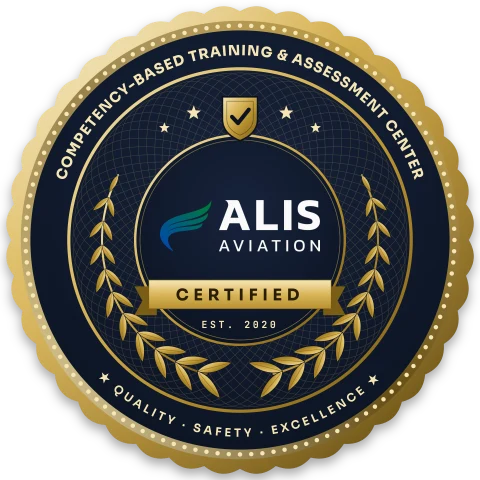
The program seal.
Schools that adopt the Alis Training Program display the Competency-Based Training & Assessment Center seal. It is an Alis Aviation seal, which identifies use of the program. It is not a certification from ANAC, ICAO or IATA.
R$ 390 per month, as an add-on to the flight schools module.
The program is sold complete, not per course: the add-on unlocks all seven courses at once for schools that use Alis's flight schools module.
Frequently asked questions
Questions about approval, courses, contracting and the program seal.
Does Alis get my school's training program approved by ANAC?+
Is CBTA mandatory for the CIAC?+
Which courses does the program have?+
Do I need to use the Alis system to have the program?+
How much does it cost?+
What is the program seal?+
See the program inside the system.
Tell us about your CIAC and the Alis team will show the seven courses in the flight schools module, mission by mission.
I’d rather talk on WhatsApp